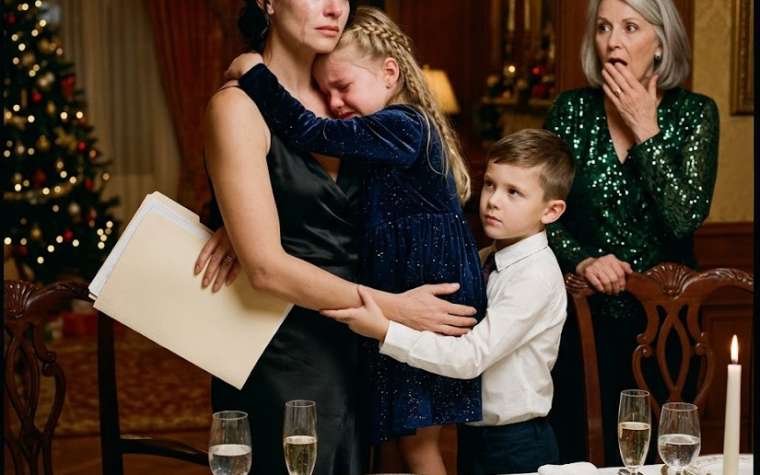
Don’t just ask about the pension.”
My sister nodded immediately.
My brother took longer.
Then he nodded too.
Whether they would completely change, I could not know that night.
People can feel guilty for an hour and return to old habits the next morning.
But at least the lie was gone.
They could no longer tell themselves I was keeping Mom because there was money in it for me.
The folder stayed open on the table while we talked.
Nobody questioned the receipts again.
Later, after my siblings had gone and the house was quiet, I helped Mom back to bed.
She seemed more tired than before.
I adjusted her pillow and placed what she needed within reach.
As I turned to leave, she called me.
“Son.”
I looked back.
Her eyes were heavy, but she was watching me carefully.
“You shouldn’t have to defend yourself for taking care of me.”
I sat beside her.
“I’m all right.”
She gave me the look mothers give when they know their children are pretending.
Then she reached for my hand.
“Thank you, son,” she whispered.
“For not leaving me alone.”
That was the sentence that mattered more than every accusation spoken in the living room.
I had never taken care of Mom because of her pension.
I had never imagined caregiving as a business arrangement where I gave time and expected profit in return.
There was no profit in watching the woman who once cared for you become unable to care for herself.
There was no advantage in waking at every sound during the night.
There was no reward in choosing medicine over things you needed for yourself.
There was only responsibility, fear, tenderness, fatigue, and love tangled together so tightly that sometimes you could not separate one from another.
The next morning, the folder was still on the table.
I closed it and returned it to the cabinet.
The receipts had done their job, but I wished they had never needed to.
I wished my siblings had asked different questions from the beginning.
How is Mom?
What does she need?
When can I come?
Can you sleep while I stay with her tonight?
Those questions would have meant more than any apology.
Because caring for a sick parent is rarely about one dramatic sacrifice.
It is built from ordinary moments repeated until they consume your days: another glass of water, another pill, another appointment, another careful walk across the room, another night listening through the wall.
From a distance, none of those things look enormous.
Together, they become a life.
I had been living that life while my siblings were discussing the pension.
Now at least they had seen part of it.
And perhaps the most painful truth was not that they had suspected me.
It was how easily suspicion had grown in the space where their presence should have been.
People who show up rarely need to guess what caregiving costs.
They see the medicine.
They hear the coughing at night.
They watch how slowly a mother rises from a chair.
They understand why the person caring for her looks tired.
They know where the money goes because they are there when it has to be spent.
My siblings had judged from a distance.
The folder brought that distance into the room and laid it in front of them, page by page.