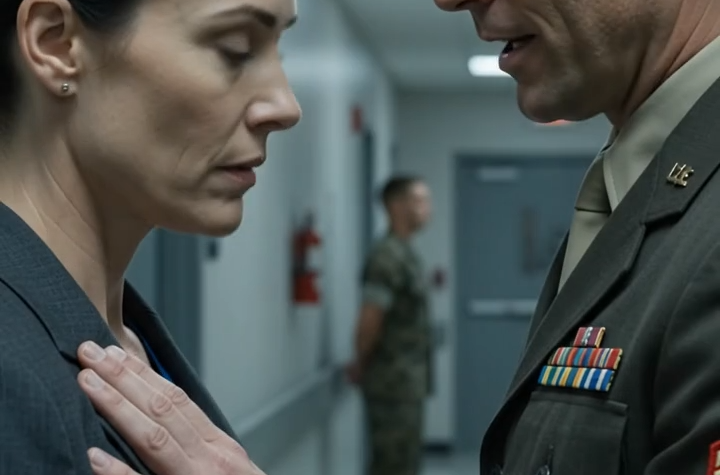
She looked down at her hands.
“I don’t want to measure this one.”
She rejected the agreement.
That was the moment I knew my daughter was coming back.
Not because she was fearless.
She wasn’t.
She still checked the locks twice at night.
Unexpected footsteps in a hallway made her shoulders tighten.
Sometimes she woke from sleep convinced someone had taken her phone again.
Courage was not the absence of any of that.
It was the decision that fear would no longer negotiate for her.
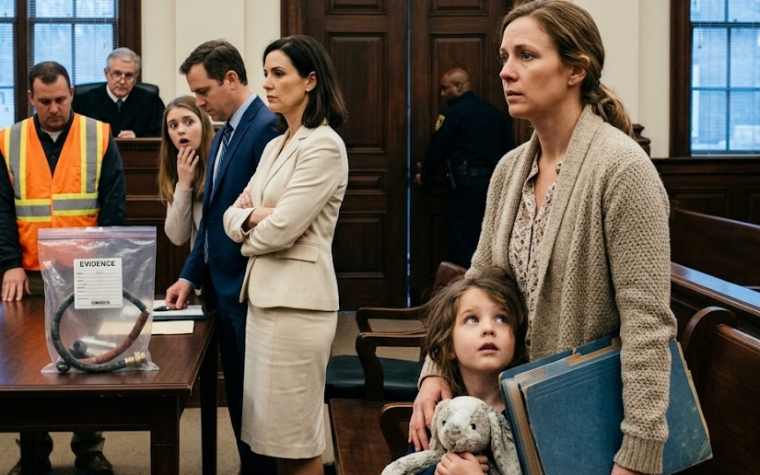
The first major court hearing drew exactly the kind of attention Victoria had once bragged she could control.
The Kensington legal team arrived with polished arguments and expensive folders.
Preston wore a dark suit and the expression of a man attending an inconvenient business meeting.
Victoria sat behind him in pearls.
I attended in civilian clothes.
That surprised them.
My uniform had never been my weapon.
I wanted no one in that courtroom confusing rank with entitlement.
Eleanor sat beside her attorney.
When Preston’s side suggested she had exaggerated a domestic argument after becoming emotional, the evidence was introduced in sequence.
The hospital documentation.
The photographs.
The nurse’s observations.
The initial statements.
The preserved hallway footage.
Then the guesthouse access history.
A screen displayed the sequence of electronic events in sterile lines of data.
Credential disabled.
Administrator access.
Door secured.
Later system alteration attempted.
Preston stopped taking notes.
Victoria leaned toward Harrison and whispered something.
The judge asked a question about the missing phone.
The answer led to the location where investigators recovered it.
Then the courtroom became very quiet.
The Kensington family’s greatest advantage had always been narrative control.
They were wealthy enough to make employees hesitate, connected enough to make people second-guess themselves, and confident enough to speak as though their preferred version of reality would become official merely because they repeated it.
But a locked door does not care about a surname.
A hospital timestamp does not care who funds a charity gala.
A preservation record does not care which newspaper prints society photographs.
And once evidence exists in multiple independent systems, intimidation becomes much harder than arrogance makes it look.
The court granted protective measures keeping Preston away from Eleanor while the criminal and civil matters continued.
The divorce moved forward.
Investigators continued examining the roles of Victoria and Harrison rather than accepting their claim that they had simply witnessed a troubled marriage.
The attempted changes to electronic records became part of that inquiry.
So did the statements made at the hospital.
The Kensingtons did not collapse in a single afternoon.
That would have been too easy and, frankly, too unbelievable.
They fought.
They hired experts.
They challenged records.
They questioned memories.
They complained about publicity while privately trying to control it.
But each tactic forced them to confront another preserved fact.