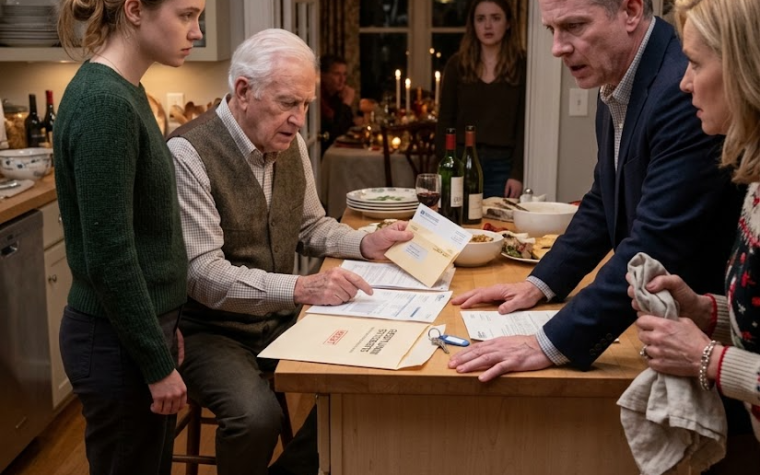
Mason glanced toward the investors before answering.
“He signed.”
“That was not my question.”
The estate attorney lifted one of the documents.
“The validity of the authorization may become a separate legal issue.”
Hunter turned sharply toward Mason.
“You said the bank wasn’t going to review that.”
Mason’s expression changed.
It was slight, but everyone saw it.
Caroline opened a thin gray file.
“First Cumberland’s internal fraud unit has already begun reviewing the loan origination materials, the medical timeline, and communications submitted by the LLC.”
One investor stood.
“I think we should leave.”
Mason blocked his path with an outstretched hand.
“No one is leaving.
We have a signed development agreement.”
The investor looked at Caroline.
“Do they own any of the land described in that agreement?”
“No,” she said.
The man removed Mason’s hand from his sleeve.
“Then we have nothing to discuss.”
The other investor followed him without a word.
Their expensive jackets disappeared through the front door.
A cold gust moved through the entryway before the door shut behind them.
Mason watched his imagined future leave the house.
Then he looked at me.
“You planned this.”
“I tried to stop it.”
He laughed once, but there was no humor in it.
“You expect anyone here to believe that?”
I removed a series of printed emails from my folder.
The first was dated three weeks earlier.
I had written to Mason and Hunter after discovering the foreclosure notice in the county records.
I asked them to call me before the redemption period expired.
Neither replied.
The second email warned that developers could obtain the ridge if the debt remained unpaid.
Mason had responded with five words.
Stay out of family business.
The third email offered to bring in my company’s legal and preservation teams to negotiate with the bank.
Hunter had answered that one.
You are not a real Whitaker.
I placed the messages in front of them.
Aunt Rebecca, who had spent the previous evening pretending not to see me carry a sleeping bag across the yard, covered her mouth.
Mason barely glanced at the pages.
“Emails prove nothing.”
“They prove you were warned,” I said.
“They prove she was circling Dad’s property before he was buried,” Hunter snapped.
I looked at him.
“Dad had already been buried when I discovered the notice.
The loan had been in default for five months.
The foreclosure had begun while he was still alive.”
Hunter looked at Mason again.
That was the first moment I understood he did not know everything.
He knew they had borrowed money.
He knew they had planned to sell the ridge.
But Mason had convinced him the sale would cover the debt before foreclosure.