“Seventy-two hours?”
“You were going to give me one night in the garage and a pen at breakfast.”
He closed the envelope.
Mason did not open his.
“You wouldn’t have any of this without Dad.”
“That is true.”
The answer confused him.
I continued.
“He taught me restoration before I knew the word for it.
He taught me that old wood could be repaired, that damage was not the same as worthlessness, and that patience mattered more than force.
My company exists because of what he taught me in that garage.”
For the first time that morning, Mason looked toward the detached building through the kitchen window.
It was the place he had chosen to humiliate me because he saw only rust, dust, and unwanted things.
I saw Dad’s hands guiding mine around a small hammer.
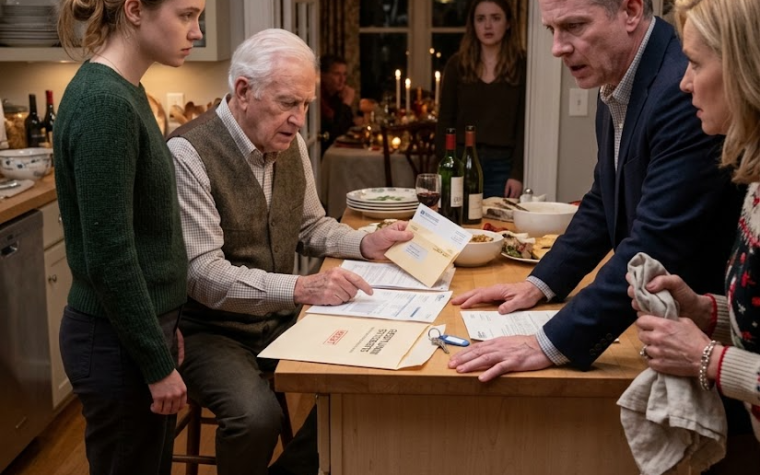
The estate attorney resumed the formal meeting.
Dad’s remaining personal assets were modest compared with what everyone had expected.
The bank accounts had been depleted by medical expenses and transfers connected to the LLC.
Several pieces of farm equipment had liens.
The bourbon collection Mason had opened for his dinner was listed as estate property.
There was no hidden fortune.
There was no second parcel waiting to rescue them.
The inheritance they had already spent in their minds did not exist.
What remained were Dad’s tools, his books, a collection of old records, several family keepsakes, and the consequences of choices made while he was unable to protect himself.
Mason interrupted repeatedly.
He disputed valuations, blamed the bank, blamed Dad’s doctors, blamed the economy, and finally blamed me for refusing to pay off the debt on his behalf.
“You had the money,” he said.
“You could have saved the property for the family.”
“I did save it.”
“For yourself.”
“For the land.”
He struck the table with his palm.
“This is my home.”
I looked at the sleeping bag still visible through the mudroom window, where he had dropped it after ordering me inside.
“Last night you said it was not mine.”
He had no answer that did not expose him.
By noon, the relatives had left.
Some apologized quietly.
Others hurried away without meeting my eyes.
Aunt Rebecca touched my arm near the front door.
“I should have said something.”
“Yes,” I said.
She nodded through her tears because forgiveness and absolution were not the same thing.
Delaney removed her engagement ring before leaving.
She placed it beside Mason’s unopened envelope.
“I am going to speak with the bank’s investigator,” she told him.
Mason stared at the ring.
“You’ll regret this.”
“I already regret enough.”
Then she walked out.
Hunter left the room soon afterward to call a lawyer.
He paused beside me in the hallway.
For one moment, I thought he might apologize.
Instead, he said, “You always thought you were better than us.”
“No,” I replied.
“I spent years believing what you told me.”
He looked away.