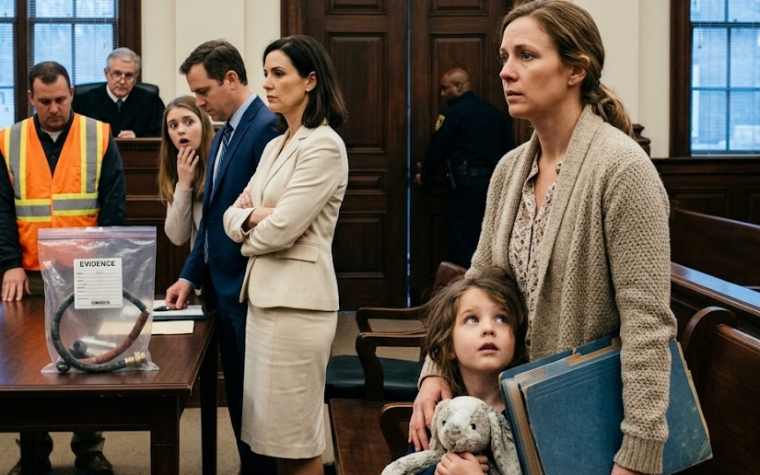
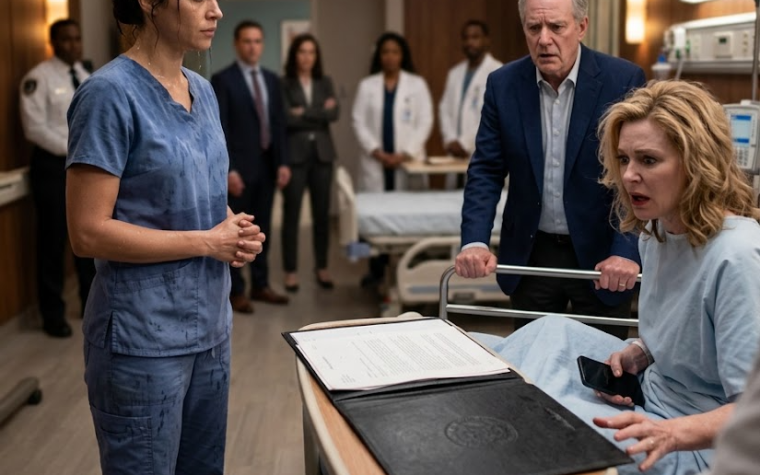
The evidence bag crackled softly as Rebecca placed it in the judge’s hands.
Robert remained standing, one hand gripping the back of his chair.
The confidence that had carried him through the hearing was gone.
His lawyer stared at the scorched pages, then at Robert, as though trying to decide which disaster required his attention first.
“Sit down, Mr.
Ashford,” the judge said.
Robert lowered himself into the chair.
The judge examined the bag without opening it.
Through the clear plastic, several lines of typed language were visible beneath smoke stains and curled black edges.
The bottom of one page had survived almost untouched.
Two signatures appeared there.
Mine and Robert’s.
Robert’s lawyer rose slowly.
“Your Honor, we object.
We have no foundation for these documents, no authentication, and no explanation for their condition.”
“You will have an opportunity to make those arguments,” the judge replied.
“First, I would like to know why your client announced that the contract did not exist before anyone described what was inside this folder.”
Robert looked at his lawyer.
His lawyer did not look back.
Rebecca stood.
Her voice remained measured.
“The pages were recovered after Mr.
Ashford attempted to destroy business records during the parties’ separation.
They were immediately photographed, sealed, and delivered to my office.
The surviving signatures, paper stock, printer marks, and handwriting notations were examined against undisputed records from the restaurant’s first year.”
“Recovered where?” the judge asked.
Rebecca glanced at me.
“Mrs.
Fox can explain.”
I took the witness chair and placed my hands in my lap.
They were steadier than I expected.
Twenty years earlier, Robert and I had stood in an empty storefront that smelled of dust, old grease, and fresh paint.
We had six tables borrowed from a closed diner, a stove that worked only when its door was held shut with a metal latch, and barely enough money to cover the first month’s rent.
The money we did have came from my mother.
She had spent years saving small amounts from sewing work and weekend catering jobs.
When she died, she left the account to me with one instruction: build something that belongs to you.
I used nearly all of it to open Harvest Table.
Robert had charm, ambition, and the ability to make strangers believe he had already succeeded.
I had the recipes, the money, the supplier relationships, and the willingness to work until my hands stopped closing properly.
Before we signed the lease, I insisted that our arrangement be written down.
Robert teased me for being cautious.
“We’re married,” he had said.
“What belongs to me belongs to you.”
“My mother’s money deserves more than a promise,” I answered.
So we sat at one of the borrowed tables after midnight and signed an ownership agreement.
It stated that Harvest Table belonged to us equally.
Fifty percent to Robert.
Fifty percent to me.
Major debts, new locations, sales of company property, and changes in ownership required both signatures.
Robert added a handwritten sentence beneath the final paragraph: Built together, owned together.
For years, the contract stayed in a metal file box beneath the office desk.
In the beginning, Robert treated our partnership as real.
He asked before making purchases.
He brought me invoices.
He called me from the dining room when a supplier wanted different terms.
When we could not afford both a manager and a chef, I became both.