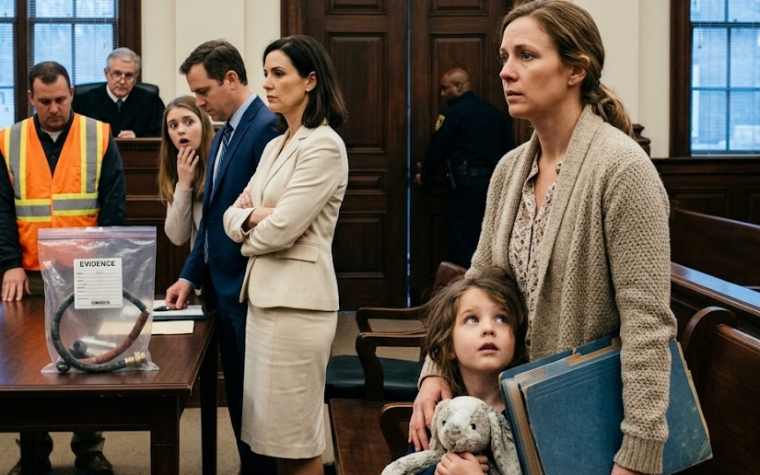
No emotional conclusions.
Only a trail another person could follow without trusting me.
The hidden account connected to the shell company.
The shell company connected to Daniel.
The transfers connected to assets that had been valued far below what internal records suggested they were worth.
Then came the appraiser.
Daniel had presented a valuation claiming one of his interests had suffered a steep decline.
That valuation had helped support his argument that much of what appeared valuable during our marriage was actually burdened, diminished, or attributable to preexisting interests.
But buried in the records was a payment routed through an entity tied to the medical group shortly before the appraisal was completed.
The recipient matched the appraiser’s business.
Voss stood again.
“A payment does not establish bribery.”
“I didn’t say it did,” Judge Marlowe replied.
I had.
And I knew the distinction mattered.
So I said nothing.
The judge looked at me.
“What corroborates this?”
I pointed to the next tab.
She opened it.
There was an email chain preserved from an account Daniel apparently believed I had forgotten existed.
The wording was indirect.
Men who believed themselves clever rarely wrote, Please falsify this appraisal for me.
Instead, they wrote about needing a number that would “fit the litigation posture.” They discussed timing.
They discussed a consulting payment.
They discussed what would happen after the divorce was completed.
Daniel finally spoke.
“Those messages are being taken out of context.”
Judge Marlowe looked at him.
“Mr.
Hale, your attorney may speak for you.”
Daniel leaned back, but the confidence was gone.
Noah looked up at me.
I squeezed his hand once.
I did not want him to understand the money.
I wanted him to understand something simpler: the adults who frightened him did not control every room forever.
Judge Marlowe reached the section marked with a plain black divider.
Voss saw it and his shoulders stiffened.
“What is this?” the judge asked.
“A witness issue,” I said.
Daniel stared at me.
That was the first moment I knew exactly which part frightened him most.
One of Daniel’s former administrative employees had contacted me after leaving the medical group.
She had seen unusual transfers and had been asked to process records under descriptions that did not match their actual purpose.
When she became uncomfortable, she was warned that speaking about company finances would destroy her career.
She had been unwilling to appear while she still believed Daniel could reach her professionally.
But she had preserved messages.
The folder contained copies.
Judge Marlowe read one silently.
Then another.
“Mr.
Voss,” she said, “was this potential witness disclosed during discovery?”
He did not answer immediately.
Daniel whispered, “Malcolm.”
Voss’s expression hardened.
“I cannot respond to assumptions regarding what my client may or may not have known about a former employee.”