The assumption that embarrassment mattered more than truth.
Sarah stared at him for another second, then at my daughter.
I could almost see two years of explanations rearranging themselves in her mind.
Caleb had told her he left a marriage already dead.
He had told her I was consumed by a child who did not exist.
He had apparently told her that the pregnancy complicated an otherwise clean ending.
But standing six feet away was the complication.
A living, laughing little girl trying to pull me toward a plate of miniature cakes.
Sarah whispered, “You knew.”
Caleb said nothing.
“You knew you had a daughter, and you let me believe Harper was dragging you through some endless divorce drama.”
“I was trying to protect what we had.”
The moment he said it, Sarah’s face went still.
I knew that stillness.
I had worn it myself on the stairs two years earlier.
It was the expression of someone hearing the exact sentence that finally made everything clear.
Sarah removed her hand from his reach.
“What we had?” she said.
“You mean what you wanted.”
He glanced toward the surrounding guests.
“We are not doing this here.”
“No,” she replied.
“You usually do it in secret first, don’t you?”
I felt something cold move through me.
Those words were close enough to my own that I wondered whether women who loved Caleb eventually learned the same language.
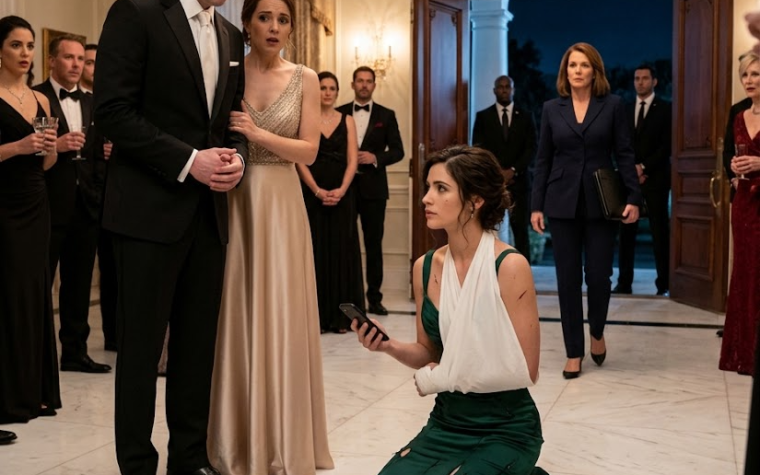
Sarah walked away.
Caleb started after her, stopped, then turned back toward me and our daughter.
For one horrible second, I saw him deciding which crisis deserved his attention.
Two years earlier, that decision would have devastated me.
Now it merely told me who he still was.
“Go,” I said.
He stared at me.
“If you want to talk about becoming part of her life, contact me tomorrow.
Not because Sarah walked away.
Not because people are watching.
Because you are prepared to show up again the day after that, and the day after that.”
His eyes dropped toward our daughter.
She had found a tiny piece of ribbon on my dress and was twisting it around her finger.
“Will you let me?” he asked.
“If you are consistent, yes.”
He seemed surprised.
I understood why.
Caleb had spent years imagining conflict as proof that someone cared.
My refusal to punish him confused him almost as much as my refusal to beg him had.
“I’m not trying to erase you,” I said.
“You did most of that yourself.”
Then I took my daughter to find the miniature cakes.
Sarah and Caleb left separately that night.
I learned later that their relationship did not survive much longer.
I never asked for the details.
Sarah never became my friend, and I had no interest in transforming betrayal into some neat alliance.
But once, months later, she sent me a short message.
She said she was sorry for participating in something she had allowed herself to understand only from Caleb’s version of events.
I accepted the apology without pretending it repaired anything.
Caleb contacted me the morning after the gala.
This time, he did not ask for a photograph.