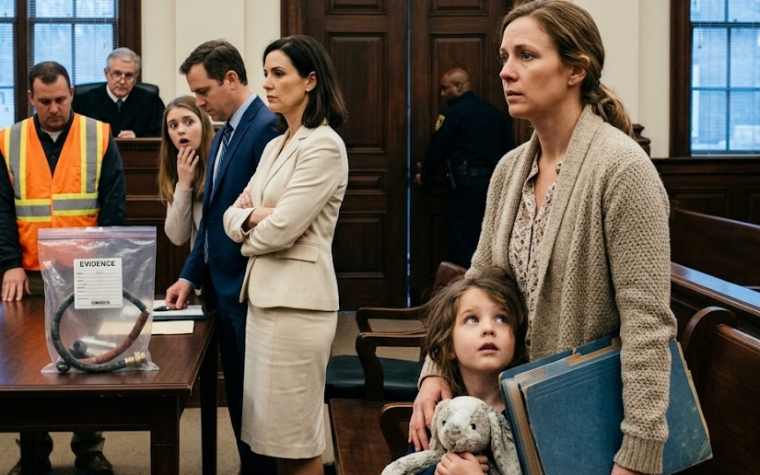
I stood at the lectern and opened the folder again.
I entered the certified deed, the payment records showing the eighty-four thousand dollars transferred to satisfy the county lien and secured debt, the attorney’s original closing letter, the notarized acknowledgment, and photographs from the signing appointment that my father had insisted on taking because he wanted to post about his move.
In one photograph, he held the deed in his own hand.
In another, he stood beside the attorney he had later claimed never to have met.
The metadata placed both photographs inside the law office on the date of execution.
My father objected repeatedly.
He called the photographs irrelevant, then fake, then private.
He said the payment had been a gift.
Minutes later, he said it had been a loan.
When the judge asked which version was true, he accused me of exploiting his age.
“You were fifty-eight when you signed the deed,” I said.
He pointed at me.
“Listen to her.
No daughter talks to her father like this.”
The judge’s voice sharpened.
“This court is evaluating evidence, not your expectations of filial obedience.”
My father dropped his hand.
I then offered the final document: a letter he had mailed me three months after the sale.
The letter thanked me for clearing his debt and confirmed that the house was now mine.
He asked me to forward any remaining mail to his new address.
His signature at the bottom matched the deed.
He stared at the page as though betrayal had come from his own handwriting.
“I was under pressure,” he said.
“Financial pressure does not invalidate a voluntary sale,” the judge replied.
“Particularly where the buyer paid substantial consideration, the seller had independent legal counsel, and the seller later confirmed the transaction in writing.”
My father changed tactics.
He leaned forward and softened his voice.
“She is my only child, Your Honor.
I made mistakes.
Families make arrangements.
Sometimes paperwork does not reflect what people truly intend.”
I had heard that voice before.
It appeared whenever anger stopped working.
The judge asked, “What did you truly intend?”
“That she would help me temporarily.”
“Then why did you execute a deed rather than a loan agreement?”
“My lawyer advised it.”
His former attorney rose from the gallery.
“Your Honor, I must object to that characterization.
I advised Mr.
Carter in writing that the transfer was permanent.”
My father turned around.
“You work for me.”
“Not anymore,” the attorney said.
The judge directed the clerk to mark the lawyer’s archived closing file for preservation and ordered him to remain available as a witness.
That was the moment my father finally understood the case was no longer about persuading a judge to frighten me.
It was about explaining why he had signed a verified complaint denying events documented by his own attorney, his own photographs, his own letter, and his own recorded voice.
He tried one final attack.
“She came back from overseas unstable,” he said.
“She fixates on details.
Records everything.
Maybe she thinks being a military lawyer makes her better than the rest of us.”
The room went still again.
My knee throbbed beneath the table, but I remained standing.
The judge looked at him for a long moment.
“Mr.