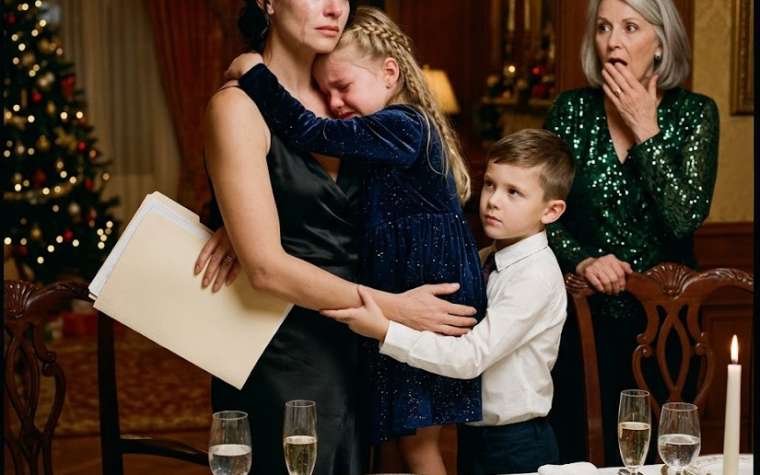
“That’s what you said when you thought you controlled the room.”
The agent asked one of the suited men to step outside and make a call.
Mark immediately followed him with his eyes.
“Who are you calling?”
Nobody answered him.
That frightened him more than anything else had.
He started pacing.
“This is a misunderstanding.
I was trying to protect the family financially.
Clara knows we have expenses.
Her father was going to need long-term care.
His Ohio house is sitting empty.
Selling it makes sense.”
I stared at him.
“Selling it?”
He stopped.
Another mistake.
I had never discussed selling my father’s house with him.
Arthur had never discussed it with him either.
The agent asked, “Had you contacted anyone about the property?”
Mark said nothing.
She opened another folder.
“Because someone did.”
The copy she showed us wasn’t a completed sale.
It was correspondence connected to a proposed transfer and financing arrangement using the Ohio property as an asset.
Arthur closed his eyes briefly.
“That’s why you wanted the deed.”
Mark pointed at him.
“You don’t understand what you’re looking at.”
Arthur opened his eyes.
“I spent half my career looking at exactly this.”
That brought me back to the question I still hadn’t been able to process.
“Dad.
Your career.”
He looked at the old identification card on the table.
“After your mother died, I told you I had worked for the government.
That was true.
I simply left out most of the details.”
“Why?”
“Because I wanted you to have a childhood that didn’t include them.”
Arthur explained that much of his work had involved financial crimes built around stolen identities, forged authorizations, vulnerable account holders, and networks that moved money through layers of apparently legitimate applications.
Years earlier, one investigation had focused on a particularly durable network.
People changed.
Company names changed.
Methods evolved.
But certain patterns repeated.
Forms.
Language.
Sequences of transactions.
Arthur had learned to recognize those patterns the way a nurse recognizes changes in a patient’s breathing.
Then, near the end of his career, he withdrew from active work and disappeared from the lives of people connected to those investigations.
He moved quietly.
He raised me.
He let the world assume he was simply another retired widower in Ohio.
“You never told Mom?”
“Your mother knew enough.”