Except I did not merely work there.
That was the truth my parents had never bothered to discover.
Six years earlier, after leaving the Sterling Group, I had used a modest inheritance from my maternal grandmother to create Aster House, a nonprofit that paid for transportation, temporary housing, medication, and legal support for transplant patients and their families.
I had started with one rented office, two volunteers, and a folding table.
My parents called it a hobby.
Within five years, Aster House operated in twelve cities and partnered with major hospitals across the country.
We had helped thousands of patients navigate the same system my parents were now trying to corrupt.
I served publicly under the shortened name Harper Vale, using my grandmother’s surname.
I did not hide out of shame.
I wanted the work judged without the Sterling name attached to it.
My parents never attended a fundraiser.
They never opened the annual reports I sent.
When newspapers requested interviews, they declined to read them because they assumed I was asking for donations.
They thought I answered phones at a charity.
In reality, I was its founder and executive director.
But that was not the page that had drained the color from my father’s face.
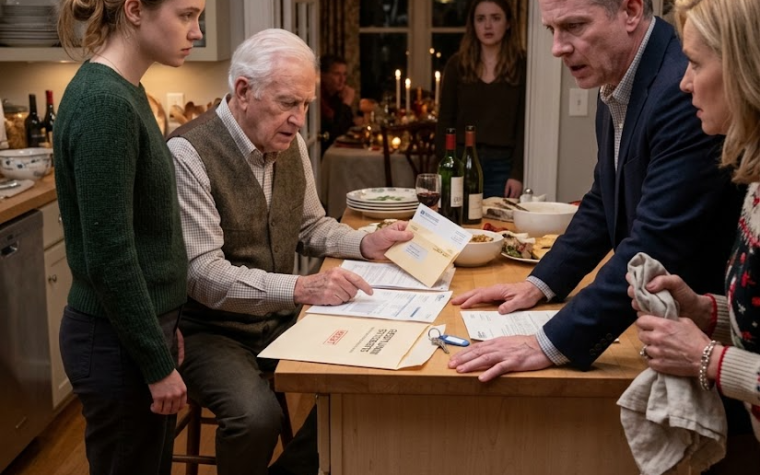
Vivian removed a thick document sealed with my grandmother’s crest.
“Do you recognize this?” she asked him.
He stared at it.
“My mother’s trust.”
“The amended Sterling Voting Trust,” Vivian corrected.
“Signed two months before Beatrice Sterling died.”
My father’s confidence finally fractured.
“That amendment was never validated.”
“It was validated six years ago.”
He looked at me as though I had stolen something from him.
My grandmother had understood her son better than I did.
She knew my father valued obedience more than competence and appearances more than character.
Before her death, she placed fifty-one percent of the Sterling Group’s voting shares into a private trust.
The beneficiary was me.
The shares remained under professional administration until I turned thirty.
When I accepted control, I chose not to announce it.
I allowed my father to remain chief executive while I studied the company’s contracts, debts, and internal culture from a distance.
He believed the board tolerated me because I was family.
The truth was that the board tolerated him because I had not yet removed him.
My mother gripped the rail of my bed.
“You control the voting trust?”
“I do.”
“For how long?”
“Four years.”
Her expression shifted from disbelief to calculation.
Even then, even after hearing me speak from the bed where she had offered my organs away, she was thinking about money.
My father stepped toward me.
“You let me run that company while you secretly held the shares?”
“I let you show me what you would do when you believed no one could stop you.”
His face reddened.
“Everything I did was for this family.”
“You charged Connor’s private medical expenses to the employee relief fund.
You used company aircraft for personal trips.
You approved contracts for businesses owned by Mother’s friends.
And last month, you tried to have me declared incompetent so you could seize the trust.”
My mother shook her head rapidly.
“That petition was protective.
You were making reckless decisions.”
“Which decisions?”
“Giving money away.