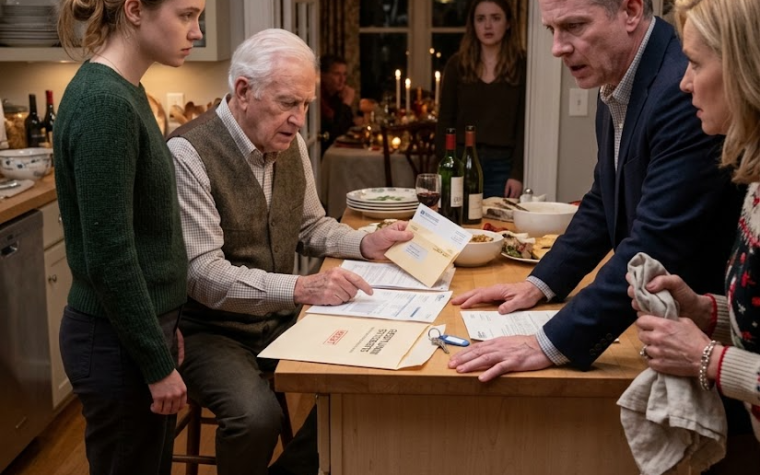
My mother refused at first.
She insisted there had been a misunderstanding, that grief had distorted her words, that any discussion of donation had been hypothetical.
Then the nurse confirmed what she had heard.
Dr.
Patel described the pressure, the forged directive, and the repeated demand to stop treatment.
Connor told the detective his parents had claimed I volunteered.
My father tried a different strategy.
He blamed my mother.
He said she had panicked about Connor and asked him to check my car because she feared I would leave town.
He claimed he had only opened the hood.
The cloud footage showed him kneeling near the brake assembly for fourteen minutes.
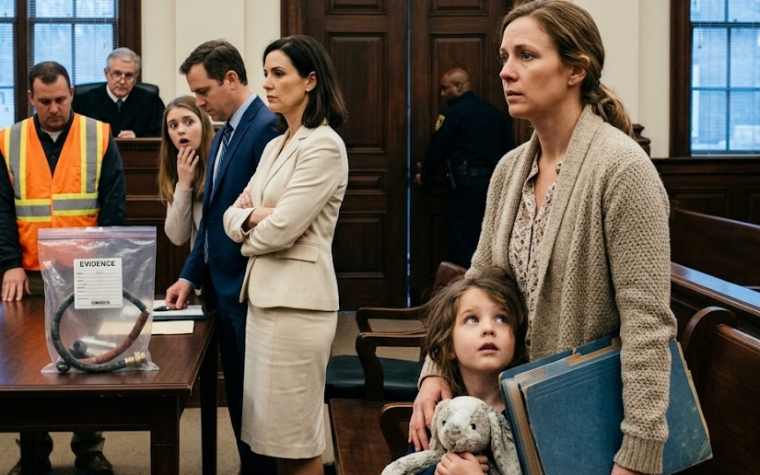
A forensic mechanic later found a clean cut in the hydraulic line, made with a narrow tool consistent with one recovered from his garage case.
His fingerprints were on the handle.
My mother’s phone records showed six calls between them during the time he was beneath my building.
The final call lasted thirty-two seconds.
Her message afterward read, “Make sure it looks accidental.”
They were arrested before sunset.
My mother cried only when the officers fastened the restraints around her wrists.
She looked at me through the glass wall of the ICU and mouthed, “Please.”
I had spent my childhood responding to that look.
It had made me apologize when Connor broke things, surrender opportunities he wanted, and remain silent when my parents called cruelty discipline.
This time, I did nothing.
My father did not look at me at all.
The criminal case moved quickly because the evidence was unusually clear.
Prosecutors charged them with attempted murder, conspiracy, forgery, and medical fraud.
Their attorneys argued that Connor’s illness had pushed them into irrational decisions.
The court rejected desperation as an excuse for planning a fatal crash.
My father’s board called an emergency meeting while I was still recovering.
I attended by secure video from a rehabilitation room, wearing a brace beneath a plain black sweater.
Vivian sat beside me.
My father’s empty chair remained visible at the head of the table.
For years, that chair had terrified me.
That morning, it looked like furniture.
I exercised the voting rights my grandmother had entrusted to me.
My father was removed as chief executive.
An independent audit began.
Contracts tied to my mother’s friends were suspended, personal expenses were repaid, and the employee relief fund received every dollar taken from it.
I did not become chief executive.
I appointed an experienced outside leader and created an ethics committee with real authority.
I had never wanted my father’s throne.
I wanted the company to stop functioning like his kingdom.
My parents were later convicted.
My father received a longer sentence because he had physically sabotaged the car and forged the medical paperwork.
My mother’s messages and hospital statements established her role in planning the crash and pressuring the doctors.
Neither of them received control of my shares, my estate, or my medical decisions.
My will left the voting interest to a permanent trust supporting Aster House.
The fortune they had tried to secure through my death would now protect patients from families, employers, and institutions that treated vulnerable people as objects.
Connor remained on the transplant list.
I did not donate to him.
Dr.
Patel made it clear that any decision made under coercion would be medically and ethically unacceptable.
Months later, Connor received a kidney from a deceased donor through the proper allocation system.
He survived.
Our relationship did not heal overnight.
Survival was not the same as accountability.
He had benefited from my humiliation for years, even when he had not arranged it.