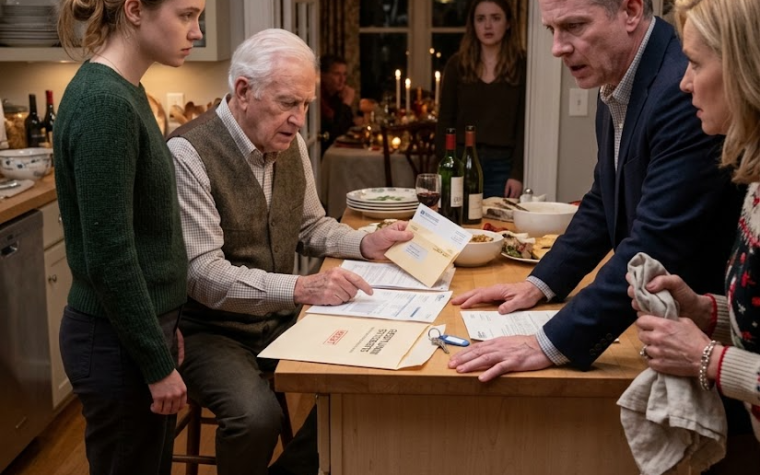
The older neighbor provided a statement too.
She wrote that Sarah had discussed changing the house’s beneficiary before any document was signed.
Daniel had not been present.
Sarah had said she wanted the house to go to the person who had treated it as a home rather than an eventual asset.
The children’s attorney requested a settlement meeting before the case went further.
We met in a conference room with a long polished table.
Sarah’s son sat across from me.
His sister sat beside him with her hands clasped so tightly that her knuckles had turned white.
Their attorney began with questions.
Had Sarah ever promised me money beyond twenty dollars a visit?
No.
Had she ever told me I would receive the house?
No.
Had I ever asked about her will, deed, savings, or property value?
No.
Why had I continued working without payment?
That question held the room longer than the others.
“At first, I believed she would pay me,” I said.
“Then I saw her refrigerator.”
Sarah’s son shifted in his chair.
I placed copies of my notes and receipts on the table.
“I needed the money.
I still need it.
But she needed food, rides, and someone who would stay long enough to make sure she got back inside safely.”
“You expect us to believe you did all of that for nothing?” he said.
“I expected twenty dollars.”
His sister lowered her eyes.
He pushed the receipts away without reading them.
“You were not her family.”
The words sounded almost identical to what he had said at the funeral.
Just the cleaner.
Not family.
A person could apparently spend months carrying someone’s groceries, learning which cupboard held the tea, and knowing which hospital entrance had the shortest walk, yet still be treated as if his presence left no mark.
I kept my voice level.
“No.
I wasn’t her family.
I was the person who answered when she called.”
His face reddened.
“You think that gives you the right to take our childhood home?”
“I didn’t take it.
Sarah made a decision.”
“She was sick.”
“She had arthritis and high blood pressure,” Sarah’s attorney said.
“Neither condition erased her legal capacity.”
Their attorney raised a hand, asking everyone to stop.
Then he turned toward Sarah’s children.
“The deed was independently prepared, properly witnessed, and recorded before death,” he said.
“The beneficiary did not know it existed.
Continuing this challenge will require evidence of coercion or incapacity that we currently do not have.”
Sarah’s son stared at him.
“You’re supposed to represent us.”
“I am.
That includes telling you the risk.”
His sister finally reached for the copy of Sarah’s letter.
Daniel had allowed the attorneys to share it, though I kept the original.
She read silently.