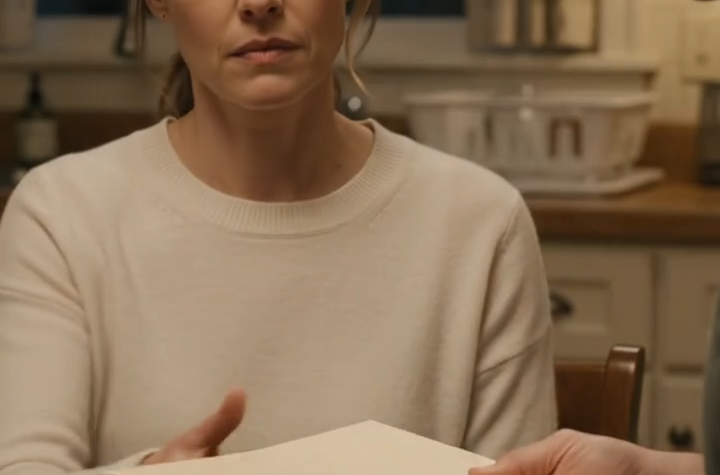
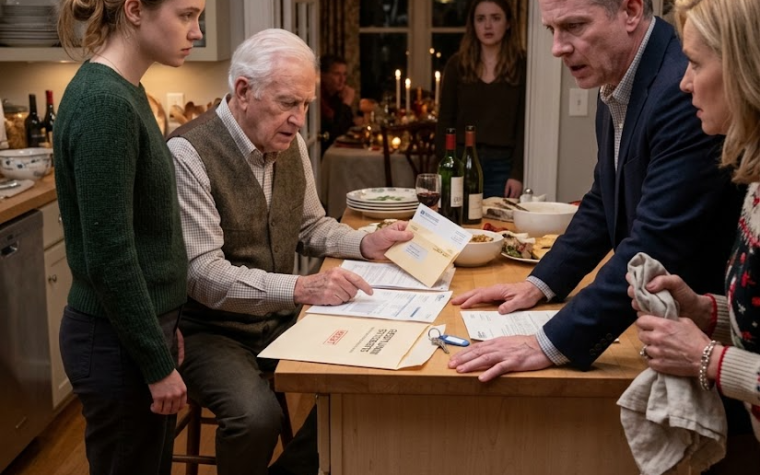
When the door opened, I recognized her immediately.
Her hair was streaked with gray.
Fine lines rested beside her eyes.
She wore a plain blue sweater and held one hand against the doorframe as though she needed its support.
For a moment, neither of us moved.
I saw the ten-year-old girl who had climbed onto my lap to open the velvet box containing the silver locket.
I saw the young woman learning bus routes beside me.
I saw the employee placing her badge on my desk.
She saw an eighty-two-year-old man bent over a cane.
“You got old,” she said.
“I practiced every day.”
Her lips tightened.
The humor almost reached her eyes, then vanished.
Emma slipped past her.
“Grandma, he almost fell down, but I saved him.”
“I heard.”
My granddaughter looked at the locket.
“You were not supposed to wear that to school.”
“You said it was lucky.”
“I said it was important.”
Emma opened it before anyone could stop her.
Inside was the tiny photograph I remembered: my late wife on one side, my granddaughter and me on the other.
The edges had faded, but our faces remained visible.
Emma pointed at the younger version of me.
“You had more hair.”
“Most of my good decisions are behind me,” I said.
My granddaughter looked directly at me.
“Not all of your bad ones are.”
The room went still.
Her daughter guided Emma toward the kitchen with the promise of hot chocolate.
When they were gone, my granddaughter stepped aside and allowed me to enter.
The apartment was modest but warm.
Family photographs covered a shelf.
In several of them, Emma sat on my granddaughter’s lap.
In another, the young woman from the bus wore a graduation robe while her mother stood proudly beside her.
There were twelve years of birthdays, holidays, and ordinary afternoons in those frames.
I had missed all of them.
“Sit down,” my granddaughter said.
I lowered myself into an armchair.
She remained standing.
“Did you come here because you saw the locket,” she asked, “or because you finally understand why I left?”
“Both.
But one happened twelve years too late.”
“You searched for me.”
“Yes.”
“Your people showed up at my work.
They questioned neighbors.
A lawyer sent a letter saying my trust could be suspended if I refused contact.”
I closed my eyes.
I remembered signing the instruction.
At the time, I had called it leverage.
Now I heard what it had truly been.
A threat.
“I authorized that letter,” I said.
She folded her arms.
“I know.”