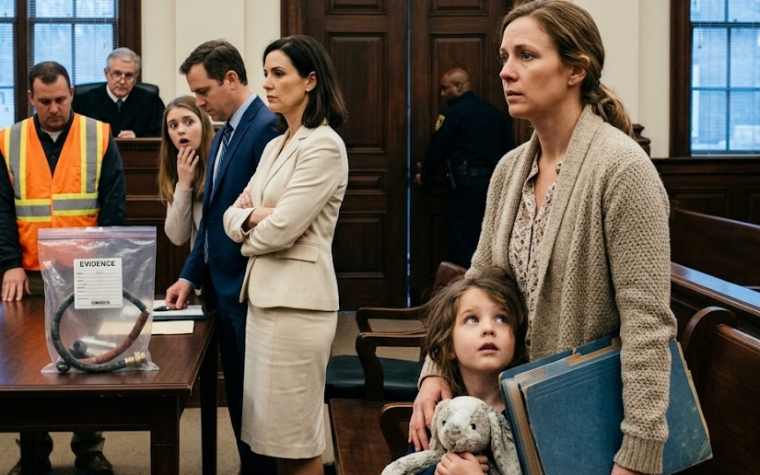
The yellow note lay between the champagne glasses like something alive.
Austin’s hand hovered above it until the child welfare caseworker ordered him not to touch the evidence.
Two ship security officers moved closer to the table, quietly blocking the nearest exit.
Around us, lunch continued in fragments.
Silverware stopped.
Conversations faded.
A waiter stood motionless beside a cart of desserts while passengers tried not to stare.
The caseworker, Elena Alvarez, placed a sealed folder beside the note and opened it.
The first photograph showed the kitchen at Austin and Monica’s house shortly after three that morning.
One weak bulb burned over the sink.
Half a loaf of bread sat open on the counter.
Two cans of soup were lined up beside an electric can opener that had been unplugged and stored on a high shelf.
The next photograph showed the refrigerator.
Inside were three bottles of water, expired milk, mustard, and a plastic container holding something Mia said she had been told not to eat.
Monica stared at the pictures, then forced a laugh.
“This is ridiculous.
Those photographs make the house look worse than it was.
Mia knew where the food was.”
Mia moved closer to me.
Alvarez did not raise her voice.
“Your daughter could not open the cans.”
“She is eight, not helpless,” Monica replied.
That sentence changed the room.
A woman at the next table lowered her eyes.
One of the security officers looked directly at Monica for the first time.
Austin tried a different approach.
“There has been a misunderstanding.
My father was supposed to take Mia.”
I looked at him across the table.
“You never called me.”
“We discussed it.”
“When?”
He opened his mouth, but nothing came out.
Alvarez removed a page from the folder.
“We reviewed Mr.
Slater’s phone records with his permission.
There were no calls or messages from either of you during the week before departure.
There was also no message asking him to care for Mia.”
Monica folded her arms.
“We left instructions.”
She gestured toward the yellow note as though it proved responsible parenting rather than abandonment.
Alvarez read it aloud.
“Mia, food is in the pantry.
Stay inside.
Don’t answer the door.
Be good.
We will call when we can.
Mom.”
Each word landed harder in the bright dining room than it had in the dark kitchen.
Austin glanced toward the surrounding tables.
His anger was not about Mia.
It was about being watched.
“Can we take this somewhere private?”
“Your daughter spent the night alone because you wanted privacy,” I said.
“You have had enough of it.”
Leo had not moved since seeing Mia.