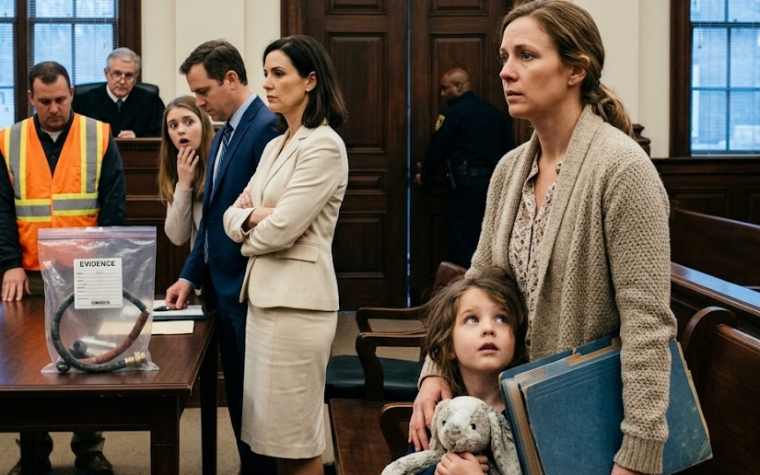
The caseworker removed several printed messages.
They were from a babysitter named Kayla, a college student who had watched both children before.
Monica had initially contacted her about the cruise dates.
Kayla wrote that she was available.
Monica replied that the family had changed plans.
Two days later, she asked whether Kayla would stop by once daily to leave food on the porch for Mia.
Kayla refused and said an eight-year-old could not be left alone.
Monica’s final message read, “Forget it.
We are not paying hundreds of dollars when she can stay inside and entertain herself.”
Alvarez placed the page on the table.
Monica’s face lost its color.
“That message is out of context.”
“What context makes it acceptable?” I asked.
Austin pointed at me.
“You had no right to bring our daughter out of the country.”
For the first time, one of the security officers spoke.
“Mr.
Slater traveled under an emergency kinship authorization issued after local authorities confirmed your daughter had been abandoned.
Port police and our legal department approved his boarding.”
Austin lowered his hand.
He had believed I had simply purchased a ticket and forced my way onto the ship.
He had not understood that the two people beside me represented a chain of official decisions made before my plane left the ground.
I had not spent the flight planning a speech.
I had spent it answering investigators, sending photographs, signing emergency documents, and trying to convince Mia that accepting a cookie would not place anyone in financial danger.
At the airport, the first card I offered had been declined.
I initially assumed it was a security hold caused by the sudden purchase.
Then I opened the banking application and saw that my online access to the Slater family emergency account had been changed twenty minutes after Mia called me.
Austin had been an authorized user because I trusted him to handle expenses for the children when necessary.
The account was funded almost entirely by me and was meant for medical bills, school costs, and emergencies involving Mia or Leo.
The recent activity showed a charge of $19,842 to the cruise company.
A second transaction covered spa packages and shore excursions.
Austin had used the children’s emergency fund to pay for the trip, then restricted my access when he realized I might follow him.
He had not known I kept cash in a safe for exactly the kind of moment when electronic convenience became somebody else’s weapon.
Alvarez now removed the bank records from her folder.
Austin saw the cruise charge and sat down slowly.
Monica looked at him.
“You said that came from your bonus.”
“Not here,” he muttered.
“You told me it was your money.”
“I said not here.”
Their united front began breaking apart in full view of the room.
Alvarez explained that the bank had frozen the remaining funds after I reported suspected misuse.
The transaction was under review because Austin had identified the cruise as an emergency family expense.
Investigators were also examining whether he had falsified my electronic approval.
Austin pushed his chair back.
“This is insane.
I am his son.
That money was going to come to me eventually.”
“It was for your children,” I said.
“I am their father.”
Mia spoke before I could answer.
“Then why did you leave me?”
Austin stopped moving.
She stood beside me in the pink shirt we had bought near the airport because the clothes she had slept in smelled like the dark house.
Her hands were clenched, but her voice was clear.
“You said the cruise was for the child worth spending money on.”