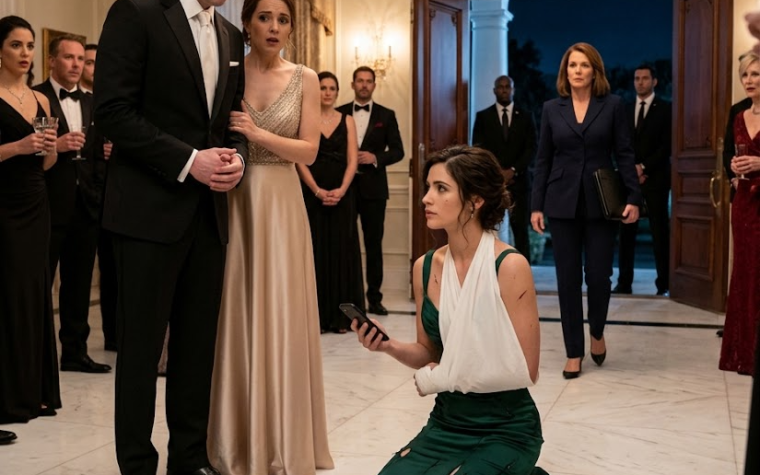
“Tonight is over.
And he doesn’t control what happens next.”
Her mother approached us.
She looked older than she had at the wedding ceremony.
“Sophia,” she began.
Sophia raised one hand.
“Not today.”
Her mother nodded.
For once, she accepted the boundary without arguing.
Sophia and I went back upstairs as sunlight entered the bridal suite.
Her wedding dress lay where we’d left it, ivory fabric pooled across the chair.
The same dress that had hidden her scars only hours earlier now looked like an ordinary piece of cloth.
Sophia stood beside it for a long moment.
“I thought you’d look at me differently,” she said.
“I do.”
She flinched slightly.
I took her hand.
“I know how much you carried by yourself.”
Her eyes filled with tears.
This time she let them fall.
I didn’t tell her she was brave.
I didn’t turn the night into a speech about strength.
I simply stayed beside her while the adrenaline drained away.
Months later, the financial investigation widened.
The records Sophia had preserved helped investigators trace transactions Mason had believed were buried behind companies and private accounts.
The criminal cases arising from the evidence moved separately, each according to its own facts and legal process.
Sophia never celebrated the proceedings.
She attended when she had to.
She answered questions when required.
She refused private contact from Mason.
Her mother eventually entered counseling and began confronting how thoroughly fear, dependence, and denial had shaped the choices she’d made.
Sophia did not offer instant forgiveness.
She told her mother that regret was not the same thing as repair.
Their relationship would have to be rebuilt, if it could be rebuilt at all.
Mason’s greatest punishment wasn’t a dramatic speech or a single humiliating moment.
It was losing the system of control that had protected him.
His money could be examined.
His threats could be played back.
His messages could be preserved.
His reputation could no longer silence a recording.
And Sophia no longer had to stand alone against his version of events.
On our first anniversary, we opened the old laptop again.
Not to listen to the recordings.
Sophia created a new folder, transferred the evidence archive to secure storage as instructed, and removed the shortcut from her desktop.
Then she closed the computer.
“I don’t want this to be the first thing I see anymore,” she said.
I understood.
The scars on her body hadn’t vanished.
Neither had the years behind them.
But they no longer belonged to Mason’s story about her.
That was the part he had never understood.
For years, he had mistaken silence for ownership.
On our wedding night, Sophia proved they were never the same thing.